This sheep brain includes the cerebrum, cerebellum, and brain stem!
Friday, April 1, 2016
Wednesday, March 9, 2016
Circulatory System: Heart, Blood Vessels, and Blood
Making Blood...
- Start with plasma (represented by yellow food coloring + water)
- Add red blood cells (cheerios soaked in red food coloring + water)
- Notice what happened to the color of blood!
- Add white blood cells (white marshmellows)
- Add platelets (tiny pieces of a peppermint marshmellow)
- Notice how sticky the platelets are!
Pig Heart Dissection...
The heart is made up of cardiac tissue. We looked at the structure of the heart: right atrium, left atrium, right ventricle, left ventricle, aorta, and vena cava. We also discussed the function of the heart and the function of valves in the heart.
Thursday, February 25, 2016
Monday, February 22, 2016
Human Body: Digestion in the Stomach
Test Tube 1: Pepsin
Test Tube 2: Hydrochloric Acid
Test Tube 3: Gastric Juices (Pepsin + Hydrochloric Acid)
Egg whites were placed in all three test tubes.
Test tubes were heated to body temperature, 37 degrees Celsius.
Monday, February 8, 2016
Friday, January 29, 2016
Friday, December 11, 2015
Wednesday, December 9, 2015
Tuesday, December 8, 2015
Cells: Shrink Film Art
Seventh graders taught fifth and K-4 students that cells are essential to life. They also discussed the structures and functions of animal and plant cells.
Monday, November 30, 2015
Cells: Photosynthesis and Cellular Respiration - Gumdrop Chemical Equations
Photosynthesis
- Plants use light energy (for example sunlight) to combine carbon dioxide (CO2) and water (H2O) to make simple sugars (C6H12O6).
- Plant cells also release oxygen gas (O2).
- Once the sugars are formed, they are either used by the plant or stored in the vacuoles.
- Photosynthesis occurs in the chloroplasts.
Respiration
- All organisms, including plants and animals, break down simple sugars (C6H12O6) into carbon dioxide (CO2) and water (H2O) and release energy.
- The cell uses the energy to build, repair, and reproduce cells.
- Respiration occurs in the mitochondria of cells.
Saturday, November 14, 2015
Cells: Osmosis
Osmosis is the diffusion of water across a membrane.
Gummy Bear
(The gummy bear hibernated in water over night)
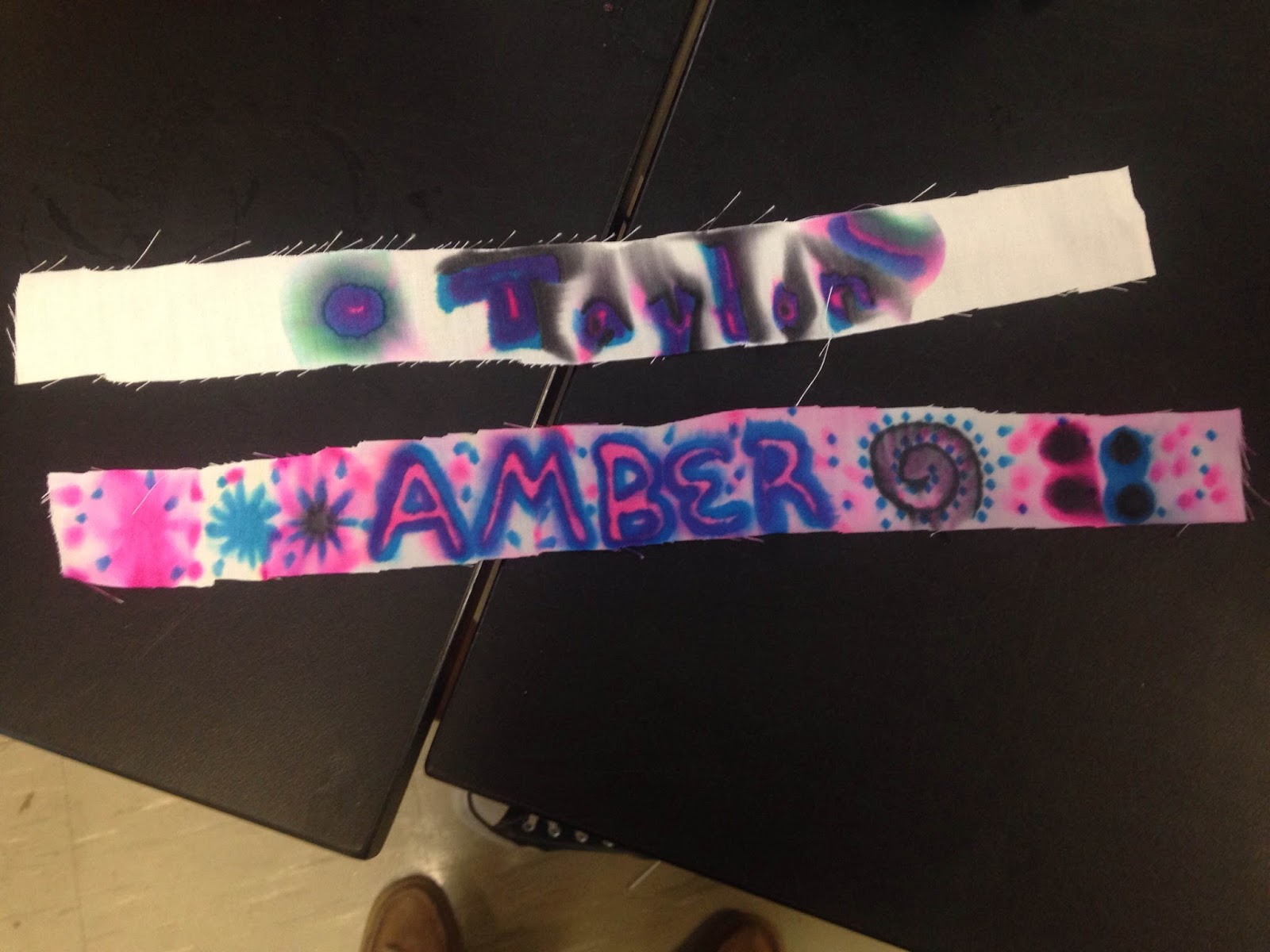
Cells: Diffusion
Diffusion is one way in which materials (for example molecules of sugar or water) move across the cell membrane. It occurs as materials are moved from an area of higher concentration to an area of lower concentration.
Strip of Fabric, Sharpies, and Rubbing Alcohol
Monday, November 2, 2015
Chemistry: Martha Paige's Study Guide for Chemistry
This may be helpful to some of you for our mid-term exam in December.
Thanks for sharing your study guide Martha Paige!
Sunday, November 1, 2015
Saturday, October 31, 2015
Chemistry: Baking Soda + Phenolphthalein & Water + Calcium Chloride
- Add phenolphthalein & water mixture to baking soda -- color change (it turned magenta because baking soda is a base)
- Add calcium chloride -- temperature change (mixture became really warm), formation of gas (bag expanded) , color change (changed back to white from magenta)
Chemistry: Dry Ice
Physical Change: Change in State of Matter
When a substance changes directly from a gas to a solid
(example: the forming of frost from water vapor)
or from a solid to a gas (examples: dry ice, solid air fresheners)
it is considered a change of state and is called sublimation.
This is still a physical change because the composition of the substance remains
the same.
Chemistry: Limewater + Carbon Dioxide
Chemical Change: Formation of a Precipitate
When two solutions are combined, they may form a solid substance.
This solid substance is called a precipitate and indicates that a chemical change has occurred.
When carbon dioxide is combined with aqueous calcium hydroxide
(limewater), solid calcium carbonate (chalk) is formed as the precipitate. The
precipitate may be in the form of very small particles, appearing as cloudiness in the
solution or as a solid which settles to the bottom of the container.
Chemical Equation:
Ca(OH)2 + CO2 → CaCO3+ H2O
(Limewater + Carbon dioxide → Calcium carbonate + water)
Chemistry: Burning Sugar
Physical Changes:
Change in State of Matter
When a substance changes from one state of matter to another and the
composition remains the same.
- Started as a solid sugar cube
- Melted into a liquid state
- Cooled and returned to solid state
Subscribe to:
Posts (Atom)